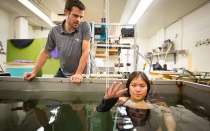
Oxygen toxicity stems from Navy divers' most precious asset--oxygen itself. Research studies may protect Navy divers from this deadly threat.
Our rigorous academic programs emphasize scientific inquiry and discovery at every level of your education.
Flexible programs let you create an individualized education that reflects who you are, helping you to develop a rewarding career path.
One of few departments in the country combining exercise and nutrition sciences in a school of public health with unique research.
Work with researchers throughout the school and university to better understand links between exercise, nutrition and disease prevention.
Improve the health of people and communities in clinical research, fitness, athletic performance, rehabilitation and health promotion.
Hear how James Sackett is exploring scuba diving safety and performance utilizing facilities that are unique to the University at Buffalo.
Dane Burke, BS
Andrea John
Julianne Stiene
Julie Marcotte Leonard
Caitlin Samson
Kunjan Shah
Carol A. DeNysschen
Maya Lambiase
Jill Eysaman-Walker
John Griffin
Kara Labounty
Jessica Nyrop
Mary Clausen, BS, MA, MS
Deborah M. Muoio
Brian Lilly
Milind Chaudhari
Aleksandra Bykowska, BS, MS
Ryan Crotin
Conor McNally
Erin Reicks
Kenneth Wojnowski Jr.
Steve Glamcevski
Courtney L. Gallagher, DI, MS
Alexander Gavronksy
Christina Weston, DI, MS
Todd Rideout, PhD Assistant Professor
Jennifer L. Temple, PhD Associate Professor
Dave Hostler, PhD Chair and Professor
Elizabeth G. Mietlicki-Baase, PhD Assistant Professor