Center for Health Research
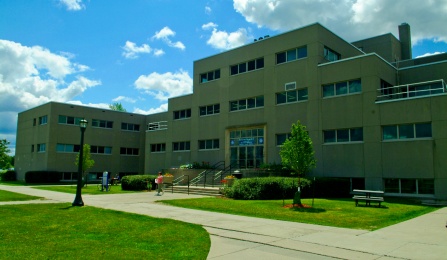

The Center for Health Research (CHR) is a full-service research facility located in Farber Hall on UB's South Campus. The CHR is available to all SPHHP faculty conducting externally funded studies.
CHR Facilities
- A reception room/waiting area
- Six interview rooms, four of which are ventilated to accommodate smoking cessation research
- Two multi-purpose rooms
- A meeting/kitchen area
- A phlebotomy room
A core group of employees (including nurses) are available to coordinate studies; screen and/or interview study participants; obtain physical measurements such as weight, height and blood pressure; draw blood and other lab work; and code and enter data. Specialized equipment includes ultrasound equipment for testing carotid IMT and brachial reactivity.
For more information, contact Debbie Saltino, CHR coordinator, at saltino@buffalo.edu or 716-829-5604.
Current Projects
Stress and Subclinical Cardio-Metabolic Disease in Police: A Longitudinal Study
Principal Investigator: John Violanti, PhD
Funding Agency: NIOSH
Period: 9/2010 - 8/2015
Abstract: Police work is one of the most stressful jobs in society, but little is known about the effects of this stress on an officer’s long-term health. The research will study how job stress affects officers over time and will provide information on specific causes of stress on police. The findings will be used to develop prevention programs for officers.
Microvascular Subclinical Cardiovascular Disease (CVD)
Principal Investigator: John Violanti, PhD
Funding Agency: CDC
Period: 8/2012 – 10/2015
Abstract: Research has been conducted on associations between cardiovascular diseases and larger blood vessels, but investigations of very small blood vessels have been far more limited. Researchers will use retinal images from a high resolution camera to examine small microvascular vessels, which may be associated with CVD. Retinal microvascular changes have been shown to be associated with chronic hypertension and clinical cardiovascular disease outcomes. Retinal arteriolar narrowing also is known to be associated with subclinical markers of cardiovascular disease. The study will also assess three cardiovascular biomarkers: Cystatin C, resistin and vitamin D.
Operation: SAFETY (Soldiers and Families Excelling Through the Years)
Principal Investigator: (Phase 1 & Phase 2) Gregory G. Homish, PhD
Co-investigator Phase 1: Lynn T. Kozlowski, PhD, John Violanti, PhD, and Kenneth E. Leonard, PhD
Co-investigator Phase 2: Kenneth E. Leonard, PhD, Bonnie M. Vest, PhD
Funding Agency: National Institutes of Health
Period: Phase 1: 06/2013 – 09/2018, Phase 2: 10/2018 - 06/2023
Abstract: Phase 1: This five-year longitudinal study will examine individual and broader social environmental influences (e.g., relationship, community and societal) on the health behaviors of soldiers and their partners. Phase 2: The second five-year phase will examine experiences with non-deployment, soldier identity, examine feelings related to separation from the military.
Using a multi-wave design, reserve soldiers and their partners (N = 400 couples) will be assessed three times over two years (i.e., baseline, Year 1, Year 2). We will examine changes in health behaviors over time on the basis of intimate partner, peer and environmental influences.
This study is significant because it will add to our limited knowledge about the social (e.g., partner/peer influences) and environmental (e.g., stress/trauma) risk factors for detrimental health behaviors that are faced by reserve soldiers. The knowledge gained from this conceptually and methodologically rigorous study will enhance the development of effective secondary prevention and intervention strategies to address the complex issues faced by military couples. Understanding the complex relation and social environmental influences and family functioning can be helpful for reducing negative outcomes and improving the health of reserve soldiers and their partners.